
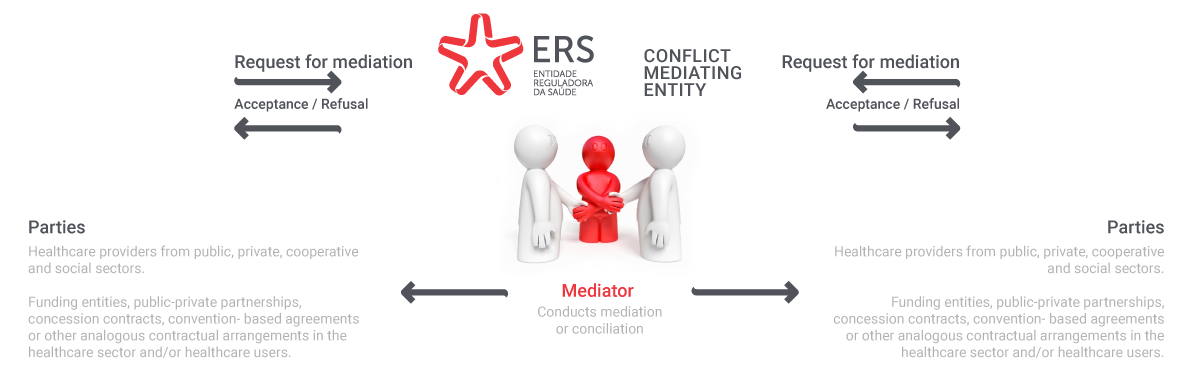
Alternative dispute resolution mechanisms, as alternatives to court proceedings, include Mediation, Conciliation, and Arbitration.
are procedures conducted through public or private bodies, by which persons or entities in dispute – the parties – voluntarily seek to reach an agreement with the assistance of a mediator.
The Portuguese Health Regulatory Authority (ERS) provides a Dispute Resolution Procedure for healthcare providers and users, with the aim of fostering a culture of dialogue, active listening, and the continuous improvement of interpersonal relationships among the various stakeholders within Portugal’s healthcare sector.
1. Mediation
With the assistance of an impartial third party – the mediator – the parties attempt, on a voluntary basis, to reach an agreement to settle the dispute between them.
2. Conciliation
Where the parties so desire, the mediation agreement, whether partial or full, may be based on a proposal submitted by the mediator.
3. Arbitration
Arbitration is not conducted by ERS. When voluntary, it constitutes a form of alternative dispute resolution in which a decision is rendered by a third party (the arbitrator). Such decision is binding upon the parties and its commencement depends on the initiative of one of them.
It is within the competence of ERS to promote voluntary arbitration for the resolution of disputes and, to that end, it may conclude cooperation protocols with existing institutional arbitration centres, such as the protocol signed with the Arbitration Centre of the Autonomous University of Lisbon (CAUAL).
In Portugal, institutional arbitration exists, and voluntary arbitration centres are recognised by the Ministry of Justice. Further information on institutional voluntary arbitration may be consulted on the portal of the Directorate-General for Justice Policy of the Ministry of Justice.
Recourse to these means of dispute resolution is distinct from lodging a complaint, as the latter does not resolve the underlying dispute.
Mediation and conciliation of disputes differ from the complaints’ procedure, as illustrated in the table.
| MEDIATION | COMPLAINT |
|
Mediation must be requested by the parties jointly or initiated by one of them with the subsequent consent of the other. The parties may withdraw from the procedure at any time, either jointly or individually. Outcome achieved: the parties themselves determine the terms of the agreement, or the absence thereof. In the context of the provision of healthcare services, mediation shall not be carried out where the dispute concerns the quality of administrative assistance or the waiting time for administrative services. The Dispute Mediation Entity may refuse the request, under the conditions laid down in the Dispute Resolution Regulation. |
A complaint is an expression of disagreement with a situation subject to criticism, conflict, dissatisfaction, displeasure, or dispute, arising from contact with any healthcare provider establishment. A complaint is unilateral and does not require the consent of the parties. Only the complainant may withdraw the complaint at any time, although ERS may nevertheless intervene within the scope of its supervisory powers. Where a litigation or consumer dispute persists during or after the closure of the complaint procedure, the parties may request ERS intervention in dispute mediation procedures. |
Dispute Mediation System
ERS provides a Mediation System for Disputes:
- Between National Health Service (SNS) healthcare establishments;
- Between National Health Service (SNS) establishments and private, cooperative and social healthcare providers;
- Within the scope of concession contracts, public-private partnership agreements, contractual arrangements under the publicly financed service provision agreements, or similar contractual relationships in the healthcare sector;
- Between healthcare providers and healthcare users.
ERS is responsible for promoting voluntary arbitration as a means of dispute resolution and may establish protocols with national institutional arbitration centres, like the cooperation protocol with the Arbitration Centre of the Autonomous University of Lisbon (CAUAL).
Check our Frequently Asked Questions on this matter.
For any further questions or clarification, please email us at mediacao@ers.pt.
Request for Mediation/ Dispute Resolution
Important Notice
All requests for mediation must be submitted in Portuguese. Requests submitted in other languages cannot be processed.
To submit a request for mediation/dispute resolution, by ERS, please complete the form:

309 309 309
(Calls to national landlines)
(9 a.m - 17:30 p.m.)

222 092 350


Rua S. João de Brito, 621 L32
4100-455 Porto


